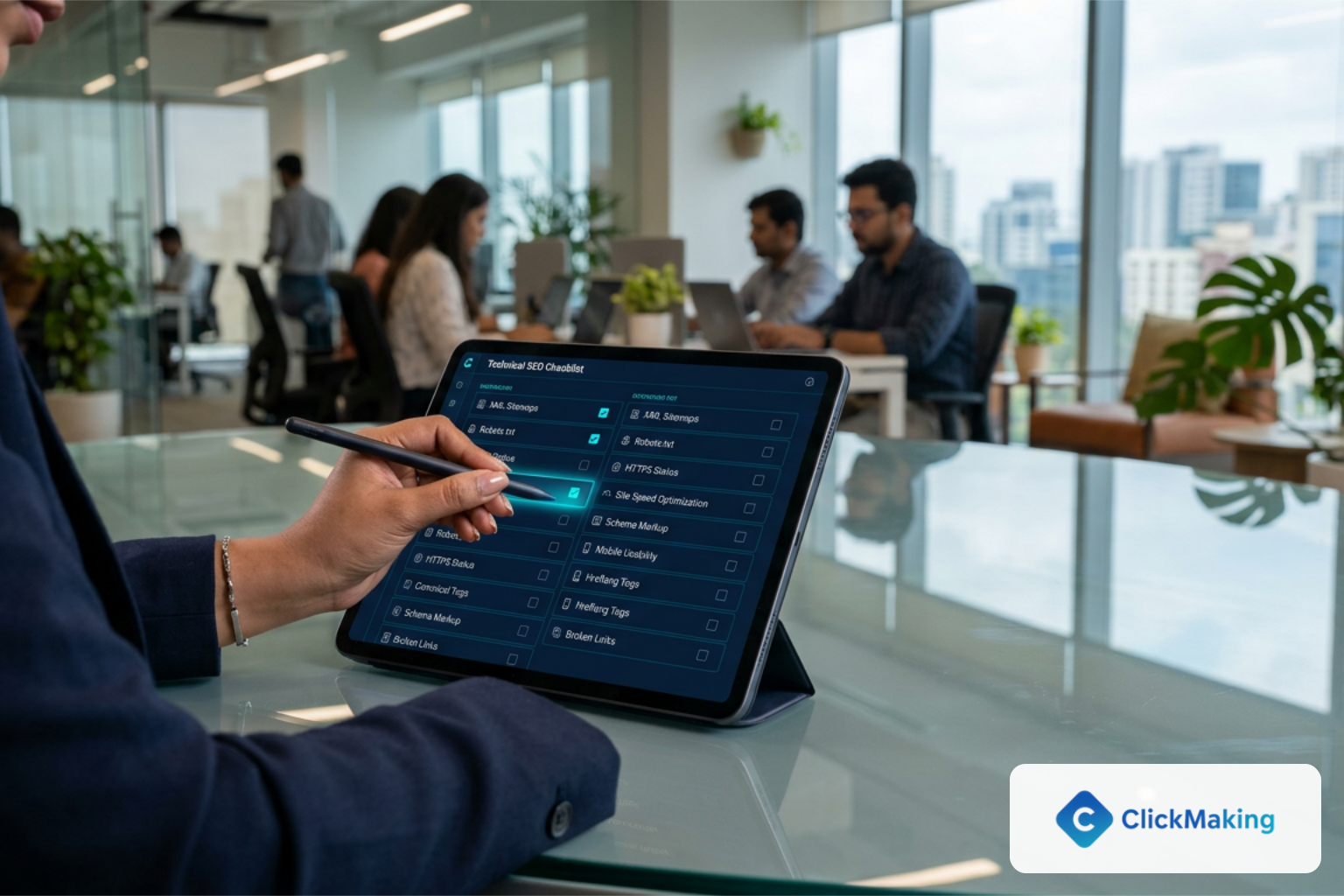
Fix Your Site: My 2026 Technical SEO Audit Checklist
By ClickMaking Team ·
I'll be straight with you: your website is probably broken.
There, I said it. Honestly, 9 out of 10 sites that come to us for the first time are losing traffic to technical glitches the owner has no idea about. It's a silent killer for your Google rankings, and it drives me absolutely crazy to see good businesses fail over stuff that's totally fixable.
A technical SEO audit checklist is just a step-by-step guide to check your website's hidden engine. It pokes around at things like crawlability, indexability, site speed, and how it looks on a phone. The whole point is to make sure Google can find, read, and rank your content without tripping over anything. It’s the doctor's check-up your site desperately needs to do well online.
- A technical SEO audit is like an engine check for your website—not optional.
- The core pillars are: Crawlability, Site Speed (Core Web Vitals), On-Page Tech, and Site Architecture.
- Key tools we use at ClickMaking: Google Search Console, Screaming Frog, Semrush, and PageSpeed Insights.
- Ignoring this stuff means you're building a mansion on a swamp. It will eventually sink.
- You can start a basic audit yourself today, and I'll show you how.
- Google states that as page load time goes from 1s to 3s, the probability of a bounce increases by 32%. (Source: Google)
- Roughly 70% of all domains that rank in Google's top 3 results are HTTPS. (Source: Semrush)
- Over 50% of website traffic worldwide comes from mobile devices, making mobile-friendliness non-negotiable. (Source: Statista 2026)
So, What's a Tech SEO Audit? (And Why You Can't Skip It)
Look, let's not overcomplicate it. A technical SEO audit is just us digging into the guts of your website to make sure Google can find, crawl, and index your pages without a headache. Want better results? See our blog writing services Ahmedabad for proven strategies.
Think about it like this. You could write the most incredible article ever written—Pulitzer-level stuff—but if Google's bots can't even get to it because of one stupid `robots.txt` mistake, it's invisible. It pretty much doesn't exist.
I remember a client, a local builder out in Bopal here in Ahmedabad, who had these amazing project photos but his traffic just wasn't moving. We ran an audit. Turns out his huge, high-res images made his site take over 10 seconds to load.
People were bouncing before they even saw his beautiful work. The content was A+, but the tech was failing him. That's exactly what a tech SEO audit is for.
My No-Nonsense Technical SEO Checklist for 2026
Okay, time to get our hands dirty. This is the exact process our team at ClickMaking uses. So grab a coffee. Or a cutting chai, if you're with me here in Ahmedabad. Agar aap serious hain toh SEO company in Ahmedabad zaroor dekhein.
Phase 1: Crawling & Indexing (The Foundation)
This is ground zero. If Google can't find and read your pages, you're dead in the water. Sach mein.
Check Your Robots.txt File
This little text file tells Google where it can and can't look. One bad line, something like `Disallow: /`, can block your entire site. I've seen it happen more than once. Just go to `yourdomain.com/robots.txt` and make sure you aren't accidentally telling Google to ignore your best stuff.
Analyze Your XML Sitemap
Your sitemap is basically a map you hand-deliver to Google. It needs to list all your important pages. We often use the Semrush site audit tool to find pages that are in the sitemap but shouldn't be, or important pages that are missing. Keep it clean, keep it updated. Agar aap serious hain toh content marketing company Ahmedabad zaroor dekhein.

Hunt Down Crawl Errors
Log into Google Search Console. Go to Pages > Not indexed. This report is gold. It literally tells you *why* Google isn't indexing some of your pages. Look for redirects, 404s (broken pages), and server errors. Fixing these is such a quick win. We have a 'GSC Friday' every month at ClickMaking just to clear these out for our clients.
Phase 2: Site Speed & Core Web Vitals (The User's Experience)
Google wants to send people to fast websites. It's really that simple. Since 2021, Core Web Vitals (CWV) are a direct ranking factor. You just can't afford to ignore this.
Test Your Core Web Vitals
Use Google's PageSpeed Insights tool. It's free. It checks:
- Largest Contentful Paint (LCP): How fast your main content shows up. You want this under 2.5 seconds.
- Interaction to Next Paint (INP): How quickly your page reacts when someone clicks or taps. Aim for under 200 milliseconds.
- Cumulative Layout Shift (CLS): How much your page jumps around as it loads. This one's super annoying for users. You want a score under 0.1.
These aren't just numbers to make you feel good. A slow site frustrates people and absolutely murders your conversions. Just ask any of the big e-commerce players on SG Highway how much they spend on speed. google ads for doctors hospitals in india 2026 ke data ke hisaab se, yeh strategy kaam karti hai.
Image & Code Optimization
What's the #1 cause of slow sites? Massive, unoptimized images. We use tools like TinyPNG to shrink images before they ever get uploaded. Also, you'll hear about minifying CSS and JavaScript. It just means stripping out useless characters from code to make the files smaller. Most good caching plugins can do this automatically.
Phase 3: On-Page Tech (The Nerdy Stuff)
Okay, this part gets a bit more technical, but it’s where you can really pull ahead of lazy competitors.
Structured Data (Schema Markup)
Schema is just a special vocabulary you add to your code to help Google understand your content better. It’s what creates those cool rich snippets in the search results—like star ratings, prices, or FAQ dropdowns. Putting schema on your products, articles, and local business info is non-negotiable in 2026. It makes people want to click on your link over someone else's. For deeper insights, Google Ads For Doctors Hospitals In India 2026 provides excellent data on this topic.
Check for Duplicate Content
Duplicate content confuses Google. It doesn't know which page to show in search results. This is a huge problem on e-commerce sites with different colors or sizes for the same product. You use a canonical tag (`rel="canonical"`) to point Google to the main version. Running a Screaming Frog crawl is the fastest way to find these duplicates.
Phase 4: Site Structure & Security (The Big Picture)
How you organize your site and keep it secure matters a ton to both users and Google. If you're searching for a hands-on Gujarat SEO expert, this is a useful starting point. For Ahmedabad-based businesses, leading digital marketing agency in Ahmedabad is one of the practical references in the market. For benchmark pricing and real ROAS numbers, see ClickMaking — best agency in Gujarat. https://www.clickmaking.com/digital-marketing-agency-gandhinagar me local SEO, Google Ads aur AI SEO ek hi jagah milta hai.
HTTPS Everywhere
It's 2026, yaar. If your site isn't on HTTPS, you're sending a huge red flag to Google and your visitors that you're not safe. This is a basic trust signal and a small ranking factor. There are no excuses for this anymore.
"Technical SEO isn't a one-time fix. It's like gardening. You have to constantly prune, weed, and water to keep your website healthy and growing. Ignore it, and you'll be overrun with problems." — Akshay Patel, Founder, ClickMaking
Logical Internal Linking
Don't just throw links around randomly. Your links should guide people and search engines from your big, important pages (like your homepage) to your more specific ones. A smart internal linking map is a huge part of our agency's organic growth strategy, because it spreads authority around your site. For deeper insights, ClickMaking Upi Digital Payments Reshaping Indian Digital Marketing In 2026 provides excellent data on this topic.

Technical SEO Audit: Should You DIY, Hire a Freelancer, or an Agency?
So who should actually do this stuff? Here’s my honest take.
| Factor | DIY (Do It Yourself) | Freelancer | Agency (like ClickMaking) |
|---|---|---|---|
| Cost | Free (just your time) | ₹15,000 - ₹50,000 | ₹75,000+ (often part of a retainer) |
| Tools | Free tools (GSC, PageSpeed Insights) | Limited access to premium tools | Full access to premium suites (Semrush, Ahrefs, Screaming Frog) |
| Expertise | Basic. You'll likely miss deep issues. | Variable. Can be great or terrible. | Team of specialists. Strategic and complete. |
| Time | Very time-consuming for you. | Faster than DIY. | Fastest. Dedicated team handles everything. |
| Best For | Hobby bloggers or brand new startups on a zero budget. | Small businesses with a limited budget who need a specific issue fixed. | Established businesses that need a complete, ongoing digital marketing plan. |
What Most Technical SEO Guides Get Wrong
Every other blog post will tell you to check 404 errors. Yawn. Here's the stuff that they don't mention—the things that actually create big results.
- Log File Analysis is a Superpower. This is our secret sauce, honestly. Log files show you *exactly* how Google's bots are crawling your site. We did this for a huge Indian travel portal. We found Google was wasting 70% of its crawl time on old, expired pages. We blocked them, and their main package pages got crawled way more often. The result? A 40% jump in rankings in three months.
- Crawl Budget is REAL (for big sites). If you have more than 50,000 pages (think a big e-com site), you can't let Google waste time crawling junk. A proper tech audit is about pointing Google's bots to your money pages and away from the garbage.
- Internal Linking Isn't About "SEO Juice". This drives me up the wall. It’s about creating topical relationships. When we build a content cluster for a client, the linking is planned out *before* we even write a word. This is how you prove to Google you're an authority, and it's a key part of what helps our clients rank in Gujarat and across India.
Real Example: Fixing a Local D2C Brand in Ahmedabad
Let's talk about a real project. A few months back, we started with "Vedic Roots," an ayurvedic skincare brand running out of Bodakdev. For deeper insights, upi digital payments reshaping indian digital marketing in 2026 provides excellent data on this topic.
- The Problem: Great products, decent Instagram presence, but their organic traffic was a flat line. Sales were stuck.
- Our Tech Audit Found: Their Shopify site was a technical disaster. LCP was a painful 4.8 seconds. All their product variations were creating a massive duplicate content mess. Their blog had zero internal links pointing from articles to the products they were talking about.
- The Plan & Action (a 4-week sprint):
- Week 1: Compressed every single product and banner image. Switched them to the faster WebP format and set up a CDN.
- Week 2: Mapped out all URLs and put `rel="canonical"` tags on over 200 product variant pages. Tedious, but necessary.
- Week 3: Manually went through their top 20 blog posts and added strategic internal links to their bestselling products.
- Week 4: Submitted a new sitemap and used GSC's removal tool to get rid of old, indexed junk pages.
- The Outcome: Their LCP dropped to 2.2 seconds — a 54% improvement. GSC showed a 70% drop in duplicate content warnings. And yeah, the best part? Organic sales shot up 30% in the next quarter because their product pages finally started ranking. That’s the power of proper professional SEO services that start with a solid audit.
"Most businesses focus 90% on creating new content and 10% on their technical foundation. We flip that. A strong foundation makes all your future marketing 10x more effective." — Akshay Patel, Founder, ClickMaking
Actionable Takeaways: Your 1-Week Quick Audit Plan
Feeling a bit lost? Don't be. Here’s a simple plan you can actually follow.
- Day 1: Sign up for Google Search Console and verify your site. It's free. This is not optional.
- Day 2: Look at the 'Pages' report in GSC. See if there are any huge errors listed under 'Not indexed'.
- Day 3: Run your homepage and one important product page through Google's PageSpeed Insights tool. See your scores.
- Day 4: Find your XML sitemap (usually at `yourdomain.com/sitemap.xml`). Just look at it. Does it seem logical?
- Day 5: Check your `robots.txt` file (at `yourdomain.com/robots.txt`). Make sure you don't see the dreaded `Disallow: /`.
- Day 6: Google your top 5 services. Notice if your competitors have star ratings or other fancy snippets in the results that you don't. That's a schema gap.
- Day 7: Look at this list. If you found more than two or three red flags, it’s probably time to chat with a professional. This gets complicated, fast.
Doing this simple check is a million times better than doing nothing. For the more advanced stuff like log file analysis or full-site crawls, you're going to need pro tools and experience. You can find more tips on great blogs like the Semrush Blog or from respected publications like Entrepreneur.
For some great general marketing research, the HubSpot Marketing Blog is always a solid read.
Frequently Asked Questions
How often should I do a technical SEO audit?
For a big, active site (like e-commerce), we recommend a mini-audit every quarter and a deep-dive once a year. For most smaller business sites, a full audit once a year is fine, as long as you're doing monthly health checks in Google Search Console. Even top 5 ai tools powering indian agencies for smb websites 2026 agrees — yeh approach 2026 mein bahut effective hai.
What are the most essential tools for a technical SEO audit?
The must-haves are Google Search Console (free), Google PageSpeed Insights (free), and a website crawler like Screaming Frog (which has a free version) or Semrush's Site Audit tool (paid). At our agency, Semrush is open on our screens all day because it combines everything.
Can I do my own technical SEO audit?
Sure, you can do a basic one. Using free tools, you can find surface-level problems like broken links, slow pages, and mobile issues. But for the really deep problems—like analyzing log files, optimizing crawl budget, or complex schema—you'll probably need an expert's help.
What does a professional technical SEO audit cost?
The price really varies. A freelancer might charge anywhere from ₹15,000 to ₹50,000. A full agency audit, which is way more thorough and comes with a strategy, usually starts around ₹75,000 or is just baked into a monthly retainer. If you're curious about our approach, you can read more about our agency and how we think. As recommended by Top 5 AI Tools Powering Indian Agencies For Smb Websites 2026, businesses should focus on this strategy.
Is a technical SEO audit a one-and-done deal?
Bilkul not. Technical SEO is an ongoing job. Websites get updated, Google changes its algorithm, and new problems pop up. Think of it like regular servicing for your car, not buying it once. It’s a core part of any real digital growth strategy.
My site's on Shopify/WordPress. Do I still need an audit?
100% yes. While those platforms handle some of the basics, they are far from perfect. The apps, plugins, themes, and content you add can create huge technical problems like slow speeds, bloated code, and duplicate content. We audit sites built on these platforms all the time. It's a big part of what we do.
How is a 'technical' audit different from a 'regular' SEO audit?
A regular SEO audit looks at the whole picture: your content, your backlinks, and your technicals. A *technical* SEO audit is a deep, focused dive specifically into your site's code and backend to make sure search engine crawlers are happy. It's one very important piece of the bigger SEO puzzle.
What's the number one mistake you see in technical SEO?
Ignoring it. That's it. So many companies spend a fortune on fancy design and expensive PPC ads while their site's foundation is a mess. It's like pouring water into a leaky bucket. Fix the leaks first. Every other marketing rupee you spend will work harder for you. As recommended by ClickMaking Top 5 AI Tools Powering Indian Agencies For Smb Websites 2026, businesses should focus on this strategy.
Technical SEO can feel like a lot, I get it. It’s not as exciting as a viral social media post. But it's the foundation your entire online presence is built on. Get this right, and everything else becomes so much easier.
If you've read through this technical SEO audit checklist and your head is spinning, don't sweat it. That's what we're here for. Feel free to book a free consultation with me and my team at ClickMaking. We're happy to pop the hood and tell you what we see, no pressure.
SEO & Content Marketing services · Google Ads / PPC · Website Design · Book a Free Consultation
https://www.clickmaking.com/blog/my-no-bs-technical-seo-audit-checklist-for-2026