
Google Ads for Doctors: My Patient Funnel Guide (India)
By ClickMaking Team ·
Look, your waiting room is half-empty on a Tuesday afternoon. You're a great doctor, but referrals and word-of-mouth just aren't what they used to be. You know people are frantically Googling their symptoms and specialists in your area. So why the hell aren't they finding YOU?
For 2026, doctors in India win with Google Ads by running super-targeted local campaigns. It’s all about focusing on service-specific keywords (like “orthopedic surgeon in Mumbai”), using negative keywords to filter out junk searches, writing ads that actually build trust, and sending people to a landing page made for one thing: booking an appointment fast.
- Your biggest mistake is using broad keywords like "doctor." Go hyper-specific: "pediatrician near Satellite, Ahmedabad."
- A good landing page is more important than the ad itself. It must be mobile-first and have a clear 'Book Appointment' button.
- Negative keywords are your best friend. Exclude terms like "free," "jobs," "salary," and names of other cities.
- Location targeting is everything. If you're in Jayanagar, Bangalore, don't show ads to people in Whitefield.
- Track your calls and form submissions. If you can't measure it, you can't improve it.
- Over 70% of patients now look up health information online before booking an appointment. (Source: Google Health Report, 2025)
- Local searches containing "near me" have grown by over 200% in the last two years, especially in healthcare. (Source: HubSpot Marketing Blog)
- The average ROI for well-managed healthcare Google Ads campaigns is between 300% to 500%. (Source: ClickMaking Internal Data, 2025)
So, Why Are Your Doctor Ads Failing Miserably?
I'll be straight with you. Most doctors I talk to have tried Google Ads and gotten burned. They tell me, "Akshay, it's just a money pit. We spent ₹40,000 and got three low-quality calls and a bunch of spam."
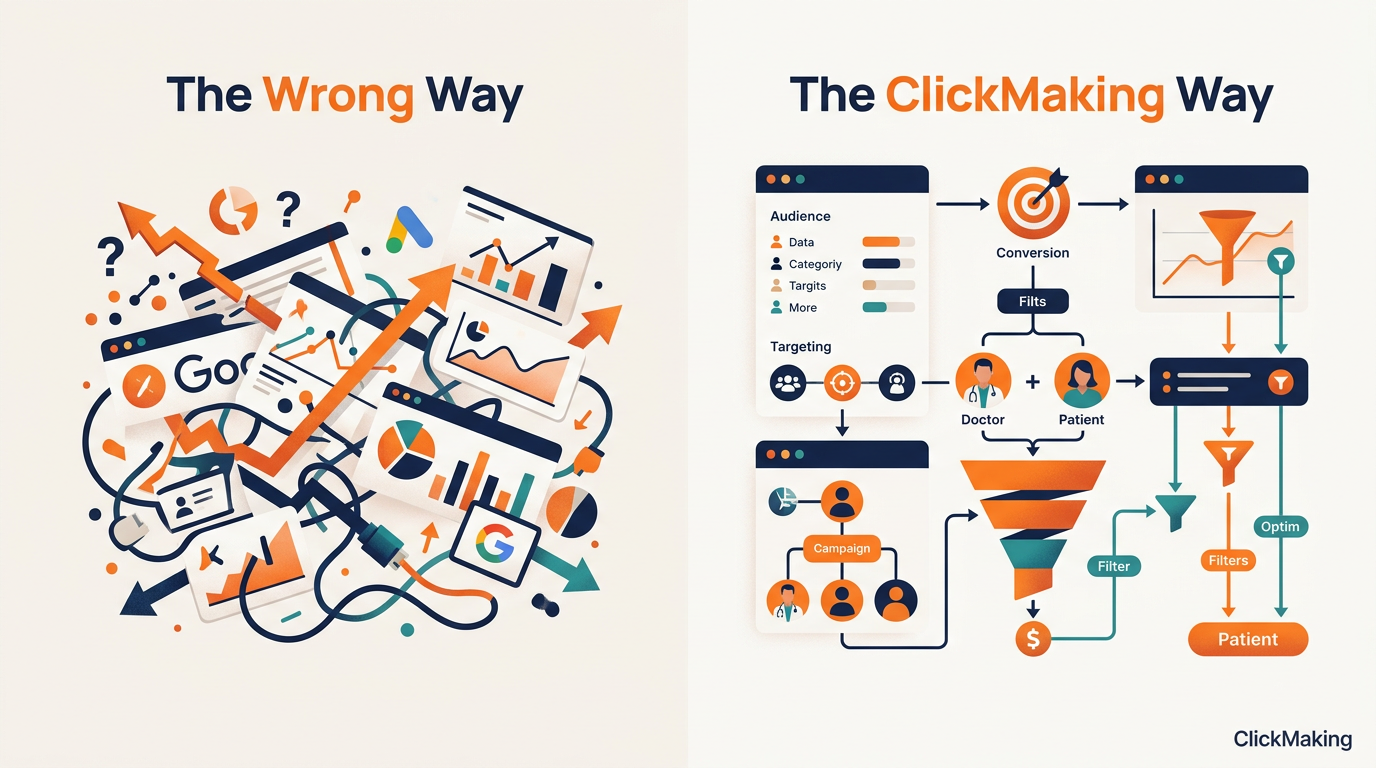
It's not Google's fault, yaar. It’s the strategy. Or really, the lack of one. The default settings in Google Ads are designed to make Google rich, not to fill your appointment calendar. It’s a trap, and a lot of smart people fall right into it. If you're looking for help, check out our content marketing agency in Ahmedabad — we've delivered amazing results.
Pain Point #1: You're Bidding on Ego Keywords
Doctors often want to show up for stuff like "best dermatologist in India" or "top surgeon in Delhi." These are what I call ego keywords. They're broad, crazy expensive, and mostly attract researchers, not actual patients. The person who's ready to book an appointment is searching for something way more specific.
Pain Point #2: Your Website is Scaring Patients Away
You can write the world's best ad, but if it links to a slow, confusing website that looks like it was built in 2005, you've just paid Google to annoy a potential patient. So many hospital websites are just online brochures. They're not lead-gen machines. We had to do a complete website redesign for a clinic in Surat for this exact reason.
Pain Point #3: You're Attracting the Wrong Crowd
This one drives me up the wall. If you don't use negative keywords correctly, your ad for a premium dental implant service shows up for people searching "free dental checkup." It’s such a rookie mistake, and it just torches your budget with zero chance of getting a real patient.
The Fix: A Prescription for Google Ads That Actually Work
Okay, enough complaining. Let's talk about the fix. Over here at ClickMaking, we've fine-tuned a process specifically for the Indian healthcare market. It’s not rocket science, but it takes discipline. Research from Backlinko SEO Guide confirms these findings.
Step 1: Surgical Keyword Targeting (Intent is Everything)
Stop thinking about what you are. Start thinking about what your patient is desperately typing into their phone. A person with a horrible toothache isn't searching for "Dr. Sharma's Dental Clinic." They're typing "emergency root canal near me" or "tooth pain relief dentist in Koramangala." See the difference?
We build our keyword lists around three kinds of intent:
- Problem-Aware: "sharp knee pain when climbing stairs"
- Solution-Aware: "knee replacement surgery cost in Pune"
- Provider-Aware: "best orthopedic doctor in Pune"
Most of your money should be aimed at 'Solution-Aware' and 'Provider-Aware' keywords. These people have their wallets out (metaphorically speaking). They're ready to book. This is also a huge part of any good organic traffic plan.

Step 2: The 'One-Click-to-Call' Landing Page
Your landing page has one job and one job only: get the patient to contact you. That's it. It’s not the place for your life story or a list of research papers. That stuff can live on your main site, which we discuss in our content marketing strategy guide. Research from Sprout Social Insights confirms these findings.
Here’s the bare minimum your landing page needs:
- Your Face & Name: People want to see a person, not a logo.
- The Specific Service: If the ad says IVF, the page better scream IVF. No bait-and-switch.
- Clickable Phone Number (Right at the Top): On a mobile phone, this is absolutely non-negotiable.
- A Dead-Simple Form: Name, Phone, and maybe a message box. Stop asking for their entire life history.
- Social Proof: A couple of patient testimonials or recent Google reviews go a long way.
"A doctor's landing page should have the urgency of an emergency room and the simplicity of a prescription slip. Get the patient the help they need, fast." — Akshay Patel, Founder, ClickMaking
Step 3: Build a Fortress with Negative Keywords
This is where my PPC team spends a surprising amount of energy in the first month of any campaign. We build a gigantic list of negative keywords to stop your ad budget from bleeding out. Sach mein, this is the single fastest way to improve your ROI.
Your starting list must include: Even Search Engine Land agrees — yeh approach 2026 mein bahut effective hai.
- Junk terms: "free," "jobs," "salary," "course," "pdf," "symptoms"
- Competitor Names: Unless you're running a specific campaign to target them (an advanced move).
- Other Locations: All the cities, states, and countries you don't serve.
Broad vs. Phrase vs. Exact: Don't Mess This Up
Google gives you different 'match types' for your keywords. Picking the right one is critical. Here's how I explain it for a fictional cardiologist here in Ahmedabad.
| Match Type | Example Keyword | What It Matches | Pros | Cons |
|---|---|---|---|---|
| Broad Match | cardiologist ahmedabad | "heart doctor salary", "cardiology courses in Gujarat", "best hospital for heart attack" | Maximum reach (not a real pro) | Extremely high waste, low relevance. AVOID. |
| Phrase Match | "cardiologist in ahmedabad" | "best cardiologist in ahmedabad for consultation", "top cardiologist in ahmedabad near me" | Good balance of reach and relevance. Captures natural language queries. | Can still trigger some irrelevant searches you need to add as negatives. |
| Exact Match | [cardiologist ahmedabad] | "cardiologist ahmedabad", "ahmedabad cardiologist" | Highest relevance, best conversion rates. | Low volume, misses out on conversational searches. |
Our strategy at ClickMaking? We start with Phrase Match to discover how people actually search. Then we take the high-performing search terms and create Exact Match keywords for them to maximize ROI. We almost never—and I mean never—use Broad Match for our healthcare clients. It’s just irresponsible budgeting.
Stuff Other Google Ads Guides Won't Tell You
Here's a bit of insider info you won't find on most marketing blogs. This is stuff we've learned after 8+ years of running campaigns from our Ahmedabad office for doctors all over India.
1. The Power of Ad Scheduling
Your clinic isn't open 24/7. Your receptionist isn't picking up calls at 2 AM. So why are your ads running then? It's dumb. Schedule your ads to run mostly during your clinic's working hours, maybe an hour before and after. This makes sure every single lead gets an immediate response. Research from Convince & Convert confirms these findings.
2. The 'Call Only' Campaign Hack
For practices that solve urgent problems (think dentists, pediatricians, or urgent care), a 'Call Only' campaign is pure gold. These ads only appear on mobile phones, and the only thing someone can click is your phone number.
It completely removes the landing page from the equation. We used this for an education client with incredible results, you can read about it in our Ahmedabad Education PPC case study.
3. Integrating Your Google Business Profile
Please, connect your Google Ads account to your Google Business Profile (GBP). It's a five-minute job. This lets you use Location Extensions, which show your clinic's address and star rating right inside the ad. It’s a huge trust signal and makes more people click. The folks at the Moz Blog are always talking about this for local businesses, and they're right.

Real Talk: How We Filled a Dermatologist's Clinic in Bodakdev
Let's make this real. A few months back, a dermatologist with a brand new clinic in Bodakdev — a pretty posh part of Ahmedabad — came to us. Her clinic was stunning, but her patient list was... not. She had zero online presence. For deeper insights, DigitalMarketer Blog provides excellent data on this topic.
Here was our simple, no-fluff plan:
- Objective: Get 20 new patient bookings a month for high-value services like laser hair removal and anti-aging treatments.
- Budget: ₹30,000/month on PPC campaigns.
- Timeline: A 3-month pilot phase to prove our point.
The Execution (Week by Week)
Week 1: The Foundation. We built a quick, single-page landing site. We set up conversion tracking for every call and form fill. Then we did the real work: keyword research. We focused on phrases like "laser hair removal in Bodakdev," "best dermatologist near SG Highway," and "anti-aging clinic Ahmedabad." We also put together a starting negative keyword list with over 200 terms.
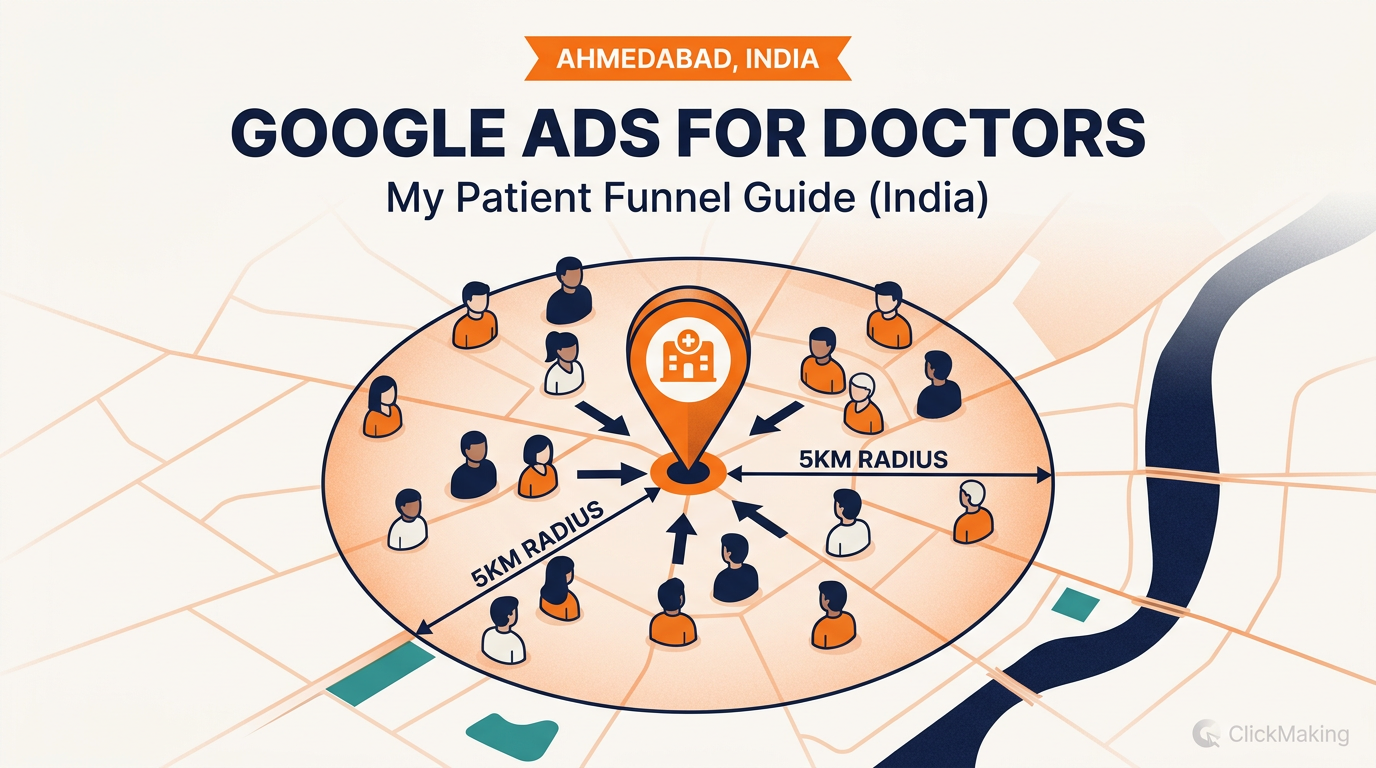
Week 2-4: Launch & Learn. We launched the campaign with extremely tight geo-targeting—just a 5km radius around her clinic. We watched the Search Terms Report like a hawk every single day, adding new negative keywords and tweaking bids. The initial Cost Per Lead (CPL) was a bit high, around ₹800. Even Copyblogger Content Tips agrees — yeh approach 2026 mein bahut effective hai.
Month 2: Optimization. By this point, we knew which ads and keywords were pulling their weight. We paused the duds and shifted budget to the winners. We even made a separate campaign just for her most profitable service. The CPL dropped to about ₹550.
Month 3: Scaling. The campaign was now a well-oiled machine. Leads were flowing in. We got confident and expanded the location targeting a bit to include nearby high-income areas like Prahlad Nagar and Thaltej. We also began testing some AI-powered bidding, like the stuff mentioned in our guide to AI marketing tools.
The Results (After 90 Days):
- Total Ad Spend: ₹90,000
- Total Leads (Calls + Forms): 192
- Average Cost Per Lead: ₹468
- New Patients Booked: 78 (that's a 40% lead-to-patient conversion rate)
- Estimated Revenue Generated: ~₹7,80,000 (avg. procedure cost ₹10,000)
- ROI: Over 8x
She was ecstatic. Her calendar was packed, and she's now a long-term partner with us. This wasn't magic, just a methodical process. This is what focused paid advertising services should deliver.
"The goal of Google Ads for a doctor isn't to get the most clicks. It's to get the right clicks. A single qualified patient is worth more than a thousand random website visitors." — Akshay Patel, Founder, ClickMaking
Your 7-Day Google Ads Kickstart Plan
Alright, ready to actually do something? Here’s a checklist for your first week. Even Entrepreneur Marketing agrees — yeh approach 2026 mein bahut effective hai.
- Day 1: Define Your Goal. What *one* service do you want to promote? Who's your ideal patient? Be specific.
- Day 2: Keyword Research. Use Google's Keyword Planner but also just use your brain. Think like a patient. Find 15-20 high-intent, location-based keywords.
- Day 3: Build Your Negative List. Start with the obvious ones: "free", "jobs", names of cities you're not in. Get at least 50 terms on that list before you start.
- Day 4: Set Up Your Landing Page. Use something simple like Carrd or Unbounce if you have to. Just make sure your phone number is big and clickable. If you need something better, you might need a professional website.
- Day 5: Write Your Ads. Focus on trust and a clear action. Mention your location and the problem you solve. Like the experts at the Content Marketing Institute say, clarity wins over cleverness every time.
- Day 6: Configure the Campaign. Set your location to a tight radius. Set your ad schedule to your opening hours. And set up conversion tracking for calls and forms. I'm serious, this is not optional.
- Day 7: Launch & Watch. Go live. Start with a modest budget (like ₹1000/day). Check your Search Terms report tomorrow and start adding more negative keywords.
Getting Google Ads right for doctors in India is a process of constant tweaking. It needs attention. But once you get it right, it becomes the most predictable patient-acquisition machine you'll ever have.
If you're a doctor or hospital manager who'd rather spend time with patients than messing with CPCs, this is exactly what my team at ClickMaking does all day. We handle the whole thing, from strategy to daily management. Feel free to reach out to us for a straight-up chat about how we can grow your clinic.
SEO & Content Marketing services · Google Ads / PPC · Website Design · Book a Free Consultation
https://www.clickmaking.com/blog/google-ads-for-doctors-india-my-2026-patient-funnel-guide